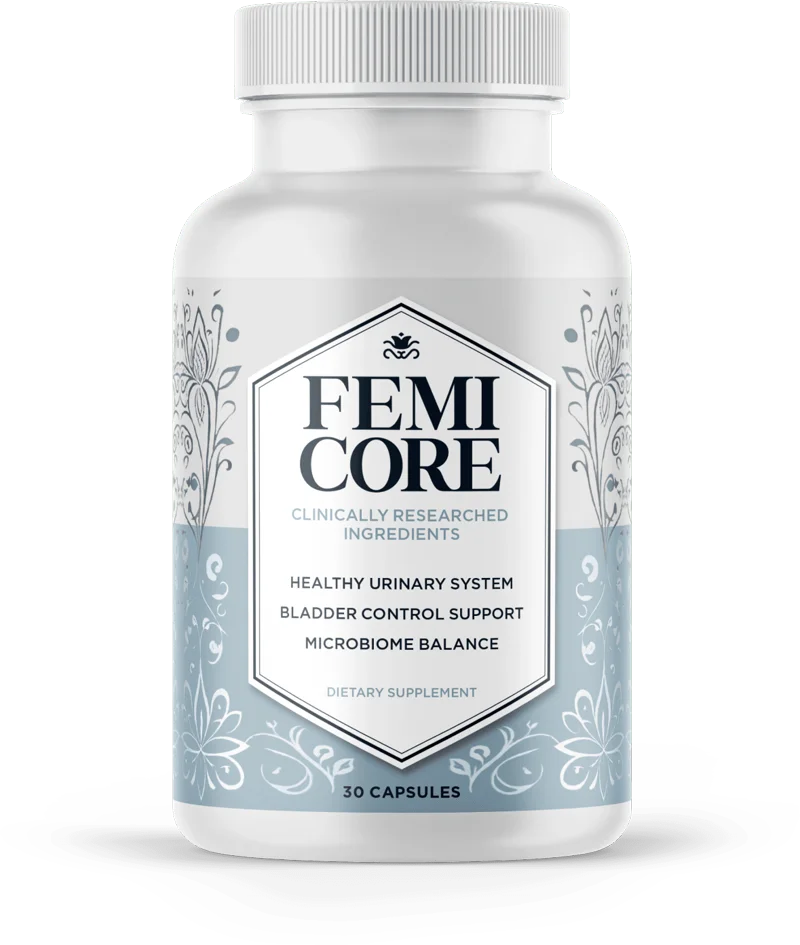
FemiCore Urinary & Microbiome Support
FemiCore is a capsule supplement built around two proprietary blends and marketed with hedged, structure-function language — support for a healthy urinary system, bladder control, and microbiome balance, the category of claim the FDA permits dietary supplements to make without drug-level proof behind it. That's a narrower promise than it might first sound like, and it's worth keeping in mind before looking at what's actually in the capsules.
What's Actually Inside
The herbal blend (350mg total) combines Mimosa pudica seed extract, cranberry extract standardized to 30% proanthocyanidin, bearberry leaf, and an 8% berberine HCl extract. The probiotic blend (50mg total) lists five named strains: Lactobacillus crispatus LCr86, L. acidophilus LA88, L. plantarum N13, L. gasseri LG08, and L. casei LC16. Naming five specific strains by identifier is more transparent than a lot of proprietary-blend probiotics manage — but naming them isn't the same as dosing them. Nothing on the label says how many milligrams of cranberry extract versus bearberry versus berberine sit inside that 350mg total, or how many colony-forming units come from each of the five strains inside the 50mg total.
The Evidence Behind the Individual Ingredients — And Where It's Thin
Cranberry extract standardized for proanthocyanidin content is the ingredient here with the most direct research history for urinary-tract support; trial results across the literature have been mixed, with more recent meta-analyses more equivocal than some of the earlier, smaller studies. Certain Lactobacillus strains, including L. crispatus, have genuine research behind their association with a healthy vaginal and urinary microbiome, though we didn't locate a clinical trial testing this exact five-strain combination together. Berberine's research base is real but sits almost entirely in blood-sugar and metabolic studies rather than urinary health, which makes its inclusion here a research mismatch worth naming plainly rather than a validated urinary-support ingredient. Mimosa pudica has a longer history in traditional use than in controlled human trials. None of this means the formula can't work — it means the evidence quality varies a lot ingredient to ingredient, and the proprietary-blend format keeps us from knowing how much of the better-studied ingredients you're actually getting per dose.
A Caution The Label Doesn't Raise
Bearberry leaf owes its traditional urinary use to arbutin, a compound the body converts to hydroquinone. Herbal-safety monographs generally advise against continuous daily use of uva ursi extract over extended periods, reserving it for short courses rather than everyday long-term supplementation. FemiCore's own product page doesn't flag this distinction, and a shopper taking the capsules daily for months, as multi-bottle pricing tiers implicitly encourage, wouldn't learn about it from the label alone.
Real Vendor Pricing
FemiCore is sold in three multi-bottle tiers, priced to reward buying more up front: a two-bottle, 60-day supply runs $79 per bottle; a three-bottle, 90-day supply runs $69 per bottle with free shipping; and a six-bottle, 180-day supply runs $49 per bottle with free shipping. The company backs orders with a 60-day money-back guarantee counted from the delivery date — both empty and full bottles must be returned inside that window, and return shipping is the customer's responsibility. We're stating these figures as reference information only; nothing above is a link, and prices are set by the seller and can change at any time.
Why This Earns A Grade B
FemiCore does several things better than a lot of the proprietary-blend supplements we've reviewed: it names its manufacturer and location, discloses a full ingredient list including specific probiotic strain identifiers, and states GMP-certified, FDA-registered manufacturing. That keeps it out of Grade C territory. What holds it at a B rather than an A is the combination of undisclosed per-ingredient dosing across two separate blends, no clinical trial we could locate on the finished formula itself, one ingredient (berberine) whose real evidence base doesn't line up with the product's stated purpose, and a bearberry safety consideration the manufacturer doesn't surface on its own.
Anyone pregnant, nursing, taking prescription medication — particularly blood-sugar or blood-pressure medication, given the berberine content — or managing an existing kidney or liver condition should talk to a healthcare provider before starting FemiCore, and should ask specifically about the bearberry ingredient if planning to take it for an extended period.
If the dosing-transparency gap above is a dealbreaker, the more evidence-backed piece of FemiCore's own formula — standardized cranberry extract — is available on its own with the milligram and proanthocyanidin content printed directly on the label: NOW Foods Cran-Max Cranberry Extract. It won't replicate FemiCore's probiotic blend or its other herbal ingredients, but you'll know exactly what dose of the best-studied ingredient you're taking. As an Amazon Associate, we earn from qualifying purchases.
Check Current Listing on Amazon →Talk to a healthcare provider before starting any new supplement, especially if you are pregnant, nursing, taking prescription medication, or managing a kidney or liver condition. These statements have not been evaluated by the FDA. This product is not intended to diagnose, treat, cure, or prevent any disease.