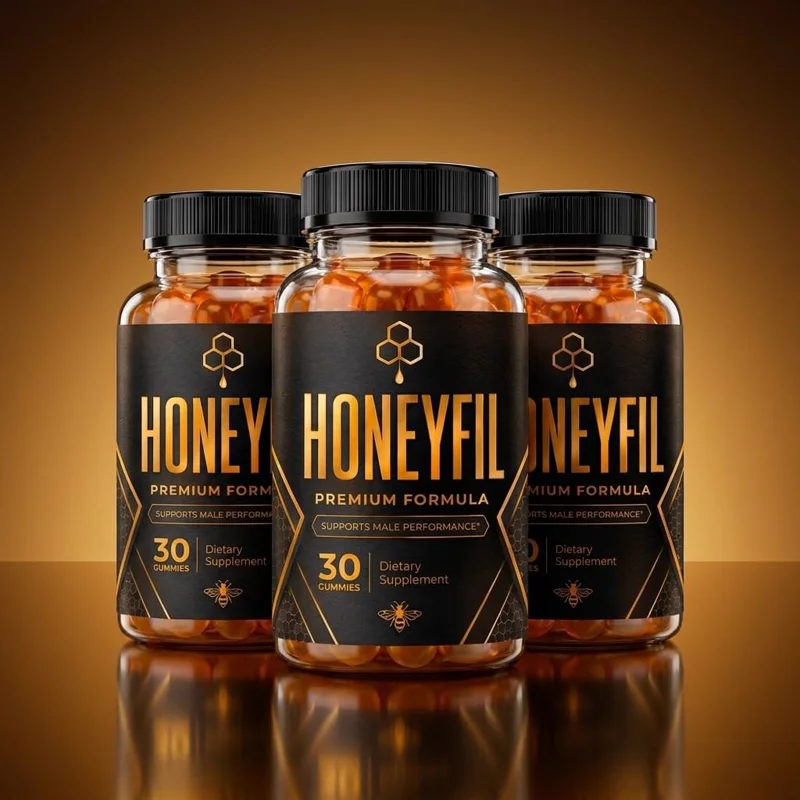
Honeyfil
This entry is unpaid and independent. When we do point to a specific product, we link to authorized retailers and may earn a commission at no extra cost to you.
What Honeyfil is marketed as
Honeyfil is sold as a once-daily gummy built around raw honey extract and a stack of adaptogenic herbs, framed broadly as a men's energy-and-vitality product. The brand's own marketing, along with its listings on other review sites, layers on additional claims about men's health that go beyond general energy support — claims we couldn't independently verify. So this report sticks to what could actually be confirmed: the ingredient list, the company behind the product, and the buying process.
The eight ingredients, cross-checked
Two independent sources — Honeyfil's own site and a separately published review — list the same eight names: raw honey extract (positioned as a chrysin source), KSM-66® ashwagandha root, tribulus terrestris standardized to 45% saponins, chelated zinc bisglycinate, black maca root, Korean red ginseng, vitamin D3, and Testofen® fenugreek seed extract standardized to 50% fenusides. Every one of those is a real, commonly used supplement ingredient with its own body of research behind it. What neither source discloses is how much of each ingredient sits in a single gummy — and without a milligram figure, there's no way to check whether Honeyfil's actual dose comes anywhere near the amounts used in the research these ingredients' reputations rest on.
KSM-66® ashwagandha and Testofen® fenugreek are real, standardized branded extracts with published research behind the extracts themselves, and chrysin is a genuine flavonoid found in honey and several plants. None of that research was conducted on Honeyfil as a combined formula, and none of it can confirm anything about a per-gummy dose that isn't published anywhere we looked.
The company behind the bottle
No manufacturer or legal entity is named anywhere on Honeyfil's official site. The brand describes its product as coming from an "FDA-registered, GMP-certified U.S. facility" — that's the brand's own wording; facility registration with the FDA is not the same as FDA approval of a product, and the facility claim itself couldn't be independently confirmed. Checkout and support run through Cartpanda, a third-party payment processor used by a wide range of unrelated supplement sellers; Cartpanda's Better Business Bureau profile shows a recurring pattern of complaints from customers describing denied or partial refunds. A separately published review outlet also reported that clicking through to buy briefly landed on a checkout page branded under an entirely different product name — it's unclear whether that has since been corrected. Several similarly spelled domains are also in circulation (honeyfil.com, honeyyfil.com, and honeyfil.shop among them), which isn't proof of anything on its own, but is worth knowing before entering a card number.
What it actually costs
Pricing pulled directly from Honeyfil's official checkout page: two bottles run $158 total (about $79 each), with shipping charged separately; three bottles run $207 total (about $69 each), with free shipping; six bottles run $294 total (about $49 each), with free shipping. No single-bottle option is offered. Those exact discount figures — $358 down to $158, $537 down to $207, and $1,074 down to $294 — also turn up on the official checkout pages of at least two other, differently branded supplement products. That's a real, checkable sign this checkout runs on a shared, templated sales funnel used across multiple product names, not proof of fraud by itself, but one more data point for the overall picture.
Amazon listings we chose not to link
Several listings on Amazon use the Honeyfil name or close variants — including at least one branded "Havah Honeyfil" — from what appear to be unrelated sellers. None of the manufacturer information on those listings ties back to honeyfil.com in any verifiable way. Rather than guess which listing, if any, matches the product described on the official site, none of them are linked from this page.
Why this earns a Grade C
Grade C on this site marks products built on real, checkable ingredients that are undermined by red flags substantial enough to outweigh the case for recommending the product as sold. Honeyfil fits that pattern closely: eight legitimate, named ingredients with zero disclosed dosing, no named company standing behind the product, a payment processor with a documented refund-complaint history, and a checkout ecosystem that appears shared across multiple different brand names. None of that is a verdict on ashwagandha, fenugreek, or the rest of the ingredient list — it's a verdict on this specific product, sold this specific way.
Anyone pregnant, nursing, or taking thyroid medication, sedatives, immunosuppressants, blood thinners, or diabetes medication should talk with a healthcare provider before trying an ashwagandha-and-adaptogen blend like this one. Several of the named ingredients here — including ashwagandha, Korean red ginseng, and fenugreek — carry documented interactions with those drug categories, and high-dose, long-term zinc intake can interfere with copper absorption and some antibiotics.
Rather than recommend Honeyfil itself, or guess at an unverified Amazon listing carrying its name, we'd point toward a single-ingredient option with a disclosed dose printed on the label: NOW Foods Ashwagandha, which states its per-capsule milligram amount directly on the bottle and comes from a manufacturer that has operated GMP-certified, third-party-audited facilities since 1968. It won't replicate Honeyfil's eight-ingredient blend, but you'll know exactly what dose you're taking.
Check current listing on Amazon →These statements have not been evaluated by the FDA. This product is not intended to diagnose, treat, cure, or prevent any disease. Talk to a healthcare provider before starting any new supplement.